Greece Athens Tours
What Makes Greek Orthodox Easter Special?
Considered the most important holiday on the Greek calendar and one of the richest in folklore, the celebration of Orthodox Easter (Pascha) is unique throughout Greece. Let’s explore the 10 best Greek Easter Customs and traditions, from Rhodes to Thrace. Greek Easter traditions become a herald of the spirit’s and nature’s rebirth, while Easter customs constitute a vivid aspect of the folk culture, rich in meaning and symbolism.
Holy Week Customs in Greece
Holy Thursday — Red Eggs and Tsoureki
Easter is a movable holiday. Celebrations start on the first Sunday after the full moon of the spring equinox. All over Greece, a plethora of customs and traditions are observed during the week before Easter, Holy Week. Preparations to celebrate the Resurrection start on Holy Thursday. Most housewives all over the country prepare red Easter eggs, cookies, biscuits, and tsoureki. The use of the egg is a symbol of rebirth, while the red color stands for the blood of Christ. Also, according to the Bible, when Jesus was resurrected, a woman said, “If it’s true, then my eggs will become red’.

Good Friday — The Epitaph Procession
Friday is the most sacred day of the Passion Week, the day of the culmination of the passion of Christ with the deposition from the cross and Christ’s burial. On that day, because it is a day of mourning, housewives avoid doing housework. Women bring flowers to decorate the Epitaph (Bier of Christ) in the churches. Around 9 pm, the Epitaph is taken out from each church symbolically around the church with hundreds of people following with candles. On Saturday morning, preparations start for the festive dinner, and a special soup called ” magiritsa ” is cooked.

Holy Saturday — Christos Anesti
On Saturday night, people gather in church holding white candles which they light with the “Holy Light” distributed by the priest. Midnight, when the latter chants “Christ is risen” (Christos Anesti), people exchange wishes and the so-called “Kiss of Love”. With the “Holy Light” of the candles, when they arrive home, they make three times the sign of the cross on the doorpost over the front door of their houses for good luck. Then they all gather around the table, they crack red eggs and wish one another Christos Anesti.
Easter Sunday — The Festive Banquet
Easter is by far the holiest of Greek holidays, but it is also the most joyous, a celebration of spring, of rebirth in its literal as well as figurative sense. As Greeks drive to the countryside or their villages to spend the holiday, food and drink are at the heart of all festivities. On Easter Sunday, you can hear music everywhere and people dancing from early morning until late at night.
The Easter table is one of the richest in the entire Greek culinary calendar. Lamb on the spit is the undisputed centerpiece, slow roasted over charcoal for hours, its aroma filling entire neighborhoods from early morning. Alongside it, kokoretsi, lamb offal wrapped in intestines and roasted on the spit, is considered a delicacy that divides opinion among visitors but is absolutely beloved by Greeks. Kontosouvli, large chunks of pork or lamb on a rotating spit, is another Easter Sunday staple.
The table also features spanakopita, tiropita, and horiatiki salad. Tsoureki, the sweet braided Easter bread flavored with mahlab and mastic, accompanies every meal throughout the week. Red Easter eggs are cracked between the other’s egg while keeping their own intact; the winner is said to have good luck for the entire year. The meal ends with koulourakia, traditional butter cookies shaped into braids and spirals, and galaktoboureko, a semolina custard pastry soaked in syrup.
For Greeks, the Easter meal is not simply food, it is the culmination of 40 days of Lenten fasting, a moment of pure communal joy shared across generations around a table that tells the entire story of Greek culture in a single sitting.

On Sunday, you can hear music everywhere and people dancing, while lambs, kokoretsi, and other kinds of meat are roasted. On that day, tables are full of traditional dishes that differ from area to area.

Unique Greek Easter Customs by Region
Corfu — The Pot Throwing Tradition
In Corfu, on Holy Saturday, after the First Resurrection, the inhabitants throw huge jugs full of water from their balconies! A spectacle that always causes excitement in the crowd.

Patmos — The Sacred Island of the Apocalypse
The beautiful island of Patmos, the island of the Apocalypse, as it is commonly called because St.John wrote the Apocalypse there, gathers a lot of people during the days of Easter, because it follows all the traditions faithfully. One of the most beautiful customs is that of Holy Thursday, where the representation of the Last Supper and the Washbasin takes place, the roles of the 12 Apostles are played by monks or clergy, and the role of Christ is the abbot of the Monastery of Theologos.On Easter Sunday, the 2nd Resurrection takes place in the monastery of Patmos, where the Resurrection Gospel is read in seven languages by the abbot and red eggs are distributed.

Chios — The Famous Rocket War
Of course, the most spectacular is the rocket war in Chios. It has its roots in the era of Ottoman rule and takes place between two parishes of Vrontados, the parish of Agios Markos and the parish of Panagia Erithani.

Kozani — Resurrection in the Cemetery
The inhabitants of Kozani are resurrected in the cemetery of Agios Georgios. With their candles lit, they wait for the memory of their dead as Christ Resurrected, and leave a red egg in their memory, a deeply moving gesture that connects the living with those who have passed. This tradition reflects the profound Greek belief that Easter is not only a celebration of Christ’s resurrection but of all souls. The atmosphere in the cemetery of Kozani on Resurrection night is unlike anywhere else in Greece, solemn, tender, and extraordinarily human. It is one of the most emotionally powerful Easter customs in the entire country.
Kythnos — The Easter Swing Tradition
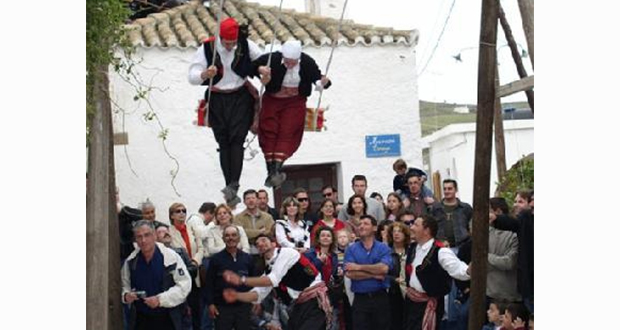
In Kythnos, on Easter Sunday, a large wooden swing is erected in the village square, a custom with roots stretching back to ancient Greek spring fertility rituals that predate Christianity itself. Young men and women dressed in magnificent traditional Kythnian costumes take turns swinging, watched by the entire community. According to tradition, if a young man manages to make a girl laugh while she is swinging, he is considered committed to marrying her, a charming custom that has survived centuries. The swing of Kythnos is a rare living example of how ancient Greek customs seamlessly blended into Orthodox Christian celebrations, creating a uniquely Greek cultural tapestry that exists nowhere else in the world.
Hydra — The Epitaph Enters the Sea
Easter in Hydra is different from anywhere else. On this island of Greece with a glorious history, the locals know how to keep the Greek Orthodox Easter traditions.

Whoever chooses to spend these holy days on the island of Hydra will live up close to the unique experience of the procession of the epitaph in the district of Kamini. The epitaph here enters the sea where the Epitaph Sequence is read, creating an all-encompassing atmosphere that is enjoyed every year by hundreds of visitors to the island. Then four epitaphs meet at the main port.
Leonidio — 1,000 Hot Air Balloons
In the small town of Leonidio, the women, singing in the gardens, gather roses, wildflowers, white, red, and purple violets to embroider the wreaths and knit the crosses that will decorate the Epitaphs of Good Friday, to make a magical procession in the neighborhoods of Leonidio at night. The girls cut oranges, oranges, and any fruit imaginable from the trees to make lanterns that will illuminate the streets and traditional alleys of the market.
But the culmination, the ecstasy of creation, the manifestation of freedom, the meaning of the Resurrection is the construction of balloons, which young, old men and women perform weeks before Holy Saturday, which have their own honorary and unique presence. Sixteen multicolored thin types of glue are joined, and at their base, around a rod, is woven, on the cross wire of which the “kolimara” will be inserted, the cloth soaked in oil and a little oil, the fuel to release it.
It is not one and two. More than 1,000 such balloons, from all the parishes of Leonidio, will make their journey on the sweet resurrection night, filling the sky with stars, declaring at the same time the Resurrection of the soul, the liberation, the cleansing from the sufferings, the exorcism evil to which of course the barrels, dynamites and sparklers contribute, which most carefully are thrown by the men and the older ones.
The burning of Judas, a pile of wood, invisible, and branches, completes the image of the Resurrection. And all this with Christ Resurrected!

Messinia — The Saitopolemos Custom
One of the oldest Easter customs in Messinia, with a focus on the city of Kalamata, is Saitopolemos. A custom with roots from the revolution of 1821, which is revived every Easter Sunday in Kalamata and a few other areas of Messinia, such as Eva, Aris, and Thuria. Every year after Holy Monday, various groups called “Bouloukia” begin their forty-day preparation.

On Easter day, at 20.00, in the northern parking lot of Nedontas, the herds of saitologists carry out the saitopole. The custom came from the intelligent use of the Greeks in the liberation war of 1821, as a kind of intimidation of the Turkish cavalry. Initially, they were improvised constructions were using gunpowder placed in an empty rod, they released a strong flame from one side that terrorized the rucksacks of the Turkish cavalry. After the end of the war, these improvised constructions evolved and became the well-known custom of Saitopolemos.
Crete — Burning of Judas
In Crete, the customs of Holy Week are many, and in addition to the well-known ones that apply throughout Greece in the villages of Crete, mainly, the following are observed:
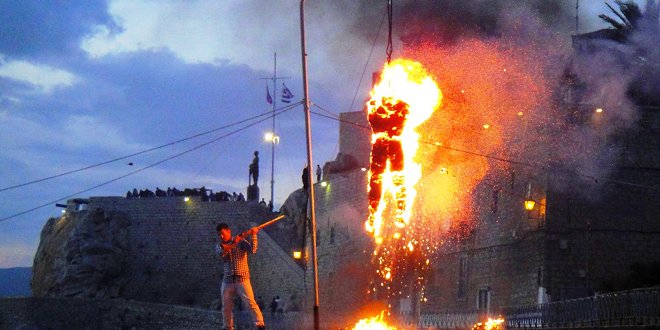
Throughout the Holy Week, they do not listen to songs, they do not sing or whistle, in the cafes they do not play cards, and with a spatula they hang the Fantis of the deck from the ceiling. The boys and the big men cut wood mainly during the Holy Week, katsoprinia, aspalathos, and other bushes, and on Holy Saturday, they make the ravine 3-4 meters high and 6-8 meters wide to burn the statue of Judas.
On Holy Thursday, they make a human figure out of wood, the “Judas”, which is circulated in all the houses of the village, and he is beaten and abused for his infamous betrayal. The women give whatever old clothes they have to dress “the filthy Judas”, which they fill with useless. The lambs for Easter are slaughtered on Holy Wednesday and Holy Thursday.
On Holy Saturday, the statue of Judas is placed in the ravine with the wood, for fear of the Jews, that is, the neighboring villages that seek to weep for Judas. On the night of the Resurrection, with Christ Resurrected, the girls set fire to Judas, who burns with the necessary ballots. On the day of the Resurrection, even enemies give the kiss of Love in the churchyard.
Experience Greek Easter in Athens
If you are visiting Athens during Easter, the city transforms into something truly extraordinary. The midnight Resurrection service at the Cathedral of Athens, the candlelit processions through Plaka, the smell of lamb on the spit filling every neighborhood on Easter Sunday- these are experiences that stay with travellers forever.
When is Greek Easter 2026?
Greek Easter Holy Week starts on April 6 and finishes on April 12.
What are the most important Greek Easter customs?
The most important Greek Easter customs include dyeing eggs red on Holy Thursday, the Epitaph procession on Good Friday, the midnight Resurrection service on Holy Saturday, where the priest chants “Christos Anesti” and distributes the Holy Light, and the Easter Sunday feast with lamb on the spit, kokoretsi, and the cracking of red eggs.
What food is eaten at Greek Easter?
Greek Easter food begins with Magiritsa, a lamb offal soup eaten after the midnight Resurrection service on Holy Saturday. On Easter Sunday, the main feast features lamb on the spit, kokoretsi, and kontosouvli. Throughout Holy Week, Greeks also enjoy tsoureki, a sweet braided bread, and red-dyed Easter eggs, which are cracked together as a tradition.
What does Christos Anesti mean?
Christos Anesti means “Christ is Risen” in Greek. It is the most sacred phrase of Greek Orthodox Easter, chanted by the priest at midnight on Holy Saturday to announce the Resurrection. Greeks respond with “Alithos Anesti” meaning “Truly He is Risen.” The moment the church lights go dark and then illuminate with the Holy Light is the most powerful experience of the Greek Orthodox calendar.
What is the Epitaph procession in Greece?
The Epitaph is a decorated bier representing the tomb of Christ, carried through the streets of every Greek town and village on Good Friday evening. Women decorate it with thousands of flowers, and hundreds of people follow the procession holding candles, creating one of the most moving and atmospheric experiences in all of Greece. In Hydra, the Epitaph uniquely enters the sea.
Where is the best place in Greece to celebrate Easter?
The best places to experience Greek Easter are Patmos for its deeply spiritual and faithful ceremonies, Hydra for the unique sea Epitaph procession, Chios for the spectacular Rocket War between two parishes, Leonidio for over 1,000 handmade hot air balloons lighting the resurrection night, and Athens for the grand midnight Resurrection service at the Metropolitan Cathedral with thousands of candlelit worshippers.